AZ PIANO REVIEWS – For Over 15 Years a Trusted online source for Digital Piano Reviews. We can also provide Lower Prices than Amazon & internet stores. Free ship & no tax on many popular new digital pianos. Check with Tim & Erik Praskins 1st! Please email us at tim@azpianowholesale.com or call 602-571-1864.
AZ PIANO REVIEWS – For Over 15 Years a Trusted online source for Digital Piano Reviews. We can also provide Lower Prices than Amazon & internet stores. Free ship & no tax on many popular new digital pianos. Check with Tim & Erik Praskins 1st! Please email us at tim@azpianowholesale.com or call 602-571-1864.
Yamaha CLP-835, CLP-845, CLP-865GP digital piano Review & Guide – Product Comparison | September 2026 | Current internet & store selling price of the Yamaha CLP-835 is $3299, CLP-845 is $4299, and CLP-865GP is $6799.In this special review of these 3 popular Yamaha digital pianos, we have a long form detailed review below discussing the major features of these 3 models while comparing them to each other. We are well-known for having the most detailed reviews out there and we thoroughly test out and examine all the digital pianos we talk about. We enjoy doing that and feel it is important for you to know exactly what you would be getting should you decide to purchase any of these Yamaha models or any other digital piano brands and models.
Beyond that, we are now including something new in our long-form review which is s new “easy to use” detailed 3-model comparison chart below.We have designed this unique comparison chart to make it as easy as possible for you to see the important specification differences and similarities among these 3 models and whether any of those specs may be important to you. Our comparison chart is like no other, and even though one or more of the digital piano manufacturers out there may provide their own spec charts, those charts can be confusing, difficult to read, and/or lacking detail that we think is important.
Below this comparison spec chart is our detailed longer-form review of these 3 models. For more info, please take a look because it will help you decide on which brand and model is best for you.
There is a lot of good information in this comparison chart, and if you have questions after you look at it, you can always contact us and ask, and we will help you. So check out our direct “hands-on” impressions of the popular Yamaha Clavinova CLP-835, CLP-845, and CLP-865GP digital pianos.
One more thing about this special comparison chart that is important to know. If you are viewing it on desktop or laptop computer, tablet, or mobile horizontal view, the chart is viewable with all product columns showing all at one time. But if you are viewing this comparison chart on mobile vertical view as many people will do, then the chart is a responsive swipeable chart where you can slide the product columns with your finger to easily see the other product columns. We do this so the chart spec info will correctly fit in the smaller mobile vertical view screen. So just keep that in mind.
Specifications & Features Comparison Chart
Specifications & Features Comparison Chart
Compare the most important specifications, features, and my independent playing evaluations to help you choose the digital piano that's right for you.
Matte Black / Matte White/ White Birch / Rosewood/ Polished Ebony(additional cost)
Matte Black / Matte White/ White Birch / Rosewood/ Polished Ebony(additional cost)
Polished Ebony /Polished White(additional cost)
Dimensions (W × D × H)
(sizes rounded up to the next nearest number)
58" × 19" × 37" Polished: 58" × 19" × 37"
58" × 19" × 37" Polished: 58" × 19" × 37"
57" × 46" × 37"
Weight
(weights rounded up to the next nearest number)
126 lb Polished: 133 lb
133 lb Polished: 139 lb
234 lb
Included Accessories
Model Number
CLP-835
CLP-845
CLP-865GP
Music Rest
Yes
Yes
Yes
Bench
Yes*
Yes*
Yes*
Power Adapter
PA-300C
PA-500
PA-500
Factory Warranty
Model Number
CLP-835
CLP-845
CLP-865GP
Factory Warranty
5 Years Parts & Labor
5 Years Parts & Labor
5 Years Parts & Labor
Key Action
The Key Action movement in any piano is the #1 most important aspect of piano playing.Without a good responsive and properly weighted keyboard in a digital piano, the other things don’t matter very much.There certainly are other important fundamental parts of any piano, whether it be digital or acoustic. But if you don’t get a good key action movement that allows you to play with proper dynamic response when the keys go up and down, along with the keys being weighted in the right way and comfortable to play, then you should really think twice about buying that piano because you may be sorry, no matter what the price of that piano may be.
For these 3 specific Yamaha Clavinova digital piano models, the key actions are good, enjoyable to play, and will satisfy most people, especially if you play music “recreationally” and are not looking for a more advanced level top-of-the-line key action movement. Overall, Yamaha Piano Company has put out impressive digital pianos over the years although they have had some key actions in the past that really were not that good in various ways. But I am happy to say that this newer “GrandTouch-S” key action is their latest iteration of key actions in this price range, and it’s a good one.
The letter “S” stands for “Short/Small” with regard to the key pivot length. The “GrandTouch-S” key action does not feel or move like a real grand piano key action for a number of reasons, based on our experience with them. In our opinion using the word “Grand” in naming this key action is somewhat misleading because an acoustic baby grand or full grand piano key action has much different keys, key lengths, and movement as compared to this “S” key action. The key movement is still good in these Clavinova models, but they are definitely not like a real grand piano. It is important to remember that just because a piano manufacturer uses the word “grand” to describe a key action part in a digital piano, does not mean that digital piano plays like a real acoustic grand piano.
On the CLP-835 and CLP-865GP, the key action keys are all plastic and they are identical to each other, which is fine. In the CLP-845, the white keys are made of wood and the black keys are made of plastic. The wood material gives the keys a bit more authenticity in touch, feel, and movement, so that is good and is an upgrade in key action movement over the other two models.
Even though the CLP-865GP comes in a mini grand piano shape cabinet and is quite a bit more money than the CLP-845, the key action in the CLP-865GP model is identical to the much lower priced CLP-835, and the CLP-845 has an upgraded key action in it (wood white keys) as compared to both the CLP-835 and CLP-865GP. Also, for all 3 piano models, the black & white key-tops have a synthetic ebony and ivory material on them to “simulate” the feel of real ivory & ebony that older acoustic pianos used to have, which is nice.
The “escapement” specification means that each key has a slight subtle notch or hesitation when the key is pressed about half-way down, but it does not interfere with the key movement. This feature is found on real acoustic grand pianos and although it’s nice to have, for me it is not a “deal-breaker” one way of the other in a digital piano. If you are an advanced pianist who is used to playing on acoustic grand pianos, then having this “escapement” key movement feature is a good thing.
Based on our piano playing experience, the gram measurement in static down-weight & up-weight of the keys when they move, is reasonably comfortable and responsive. Real acoustic pianos, especially grand pianos, have an average down-weight (aka: touch-weight) of about 55 grams or so. It can be a bit less or more. Although the CLP-835, 845, and 865GP has noticeably higher (heavier) down-weight measurements based on our findings, we found the “comfort level” and response of playing the keys up and down the keyboard was good.
Overall we like the key action in the CLP-835/865GP and also in the CLP-845. For most people who play piano recreationally at home, we believe you’ll like them as well. Yamaha does have a different and more upgraded key action in their higher price Clavinova digital pianos called the CLP-875, CLP-885, and CLP-895GP which we discuss in another review.
Piano Sound
The ability for the digital piano to have a good realistic piano sound is the 2nd most important thing in any digital piano. The Yamaha Clavinova models are no exception. The nice thing about these 3 Yamaha models is the piano “sound engine” and piano sounds are identical. The actual piano sample recordings that Yamaha has are specifically from 2 grand pianos which are the Yamaha CFX concert grand and the Bosendorfer European Concert Grand, both brands being Yamaha owned brands.
The Yamaha acoustic grand pianos are well known for having a brighter and more “punchy metallic” sound to them and are popular in pop music, rock music, country, and various other forms of music. Yamaha grands can be used for any type of music including classical, but are generally better suited towards other musical genres. European Bosendorfer grand pianos are individually hand-made in Vienna, Austria and are well known by advanced level pianists for having a loud, but noticeably more mellow “warmer” piano sound. So the availability of two distinctly different grand piano sampled sounds in these 3 Yamaha models is a good thing and offers more of a variety in acoustic piano sound “personalities.”
There are 2 main piano sounds and 11 total acoustic piano sounds which are the same in each of these 3 models. Those additional acoustic piano sounds are variations of the original Yamaha CFX & Bosendorfer piano samples. Generally speaking 11 acoustic piano sound selections is enough for most people. But for those people who want more than 2 individual piano sound samples from various sizes of grand and upright acoustic pianos, A few other brands have more selection in that way, but these Yamaha models should be enough to satisfy many people.
Also, when it comes to the piano sound in these 3 CLP models. Yamaha uses sampling technology, resonance & expression modeling technology, EQ frequency technology, and other things to get these acoustic pianos to be as “organic” as possible. With that in mind, if you were to plug in the same stereo headphones in each of these 3 models, the 11 pianos would sound the same for the CLP-835, CLP-845, or CLP-865GP.
But what really defines them and makes them sound different in each of these cabinet models is the internal speaker system and cabinet structure of these 3 Yamaha Clavinova’s. I will talk about the cabinets and internal speaker systems later on, but just keep that in mind. The piano sound that you hear coming out of each piano model is directly tied to the internal speaker systems and cabinet structure.
Finally, with regard to these acoustic piano sounds, you can adjust or alter those sounds in various ways including adding or subtracting various piano sound effects, adjusting piano sound touch sensitivity levels, and using some other editing features that can help certain people “dial in” the piano sound a bit more to their liking if they want to do that. The piano effects section of these pianos can help with that and I’ll talk about that section a bit later.
Pedals
Nearly all full cabinet style digital and acoustic pianos have 3 pedals attached to the bottom center front of the piano. Those pedals are called (from right to left) damper-sustain pedal, sostenuto pedal, and soft pedal. For recreational piano playing, most people will only use the right damper-sustain pedal for sustaining the piano sound when necessary. It takes a while to learn how to use that pedal correctly but it is not difficult and it is definitely important for just about all piano playing for every type of music.
The other two pedals are generally not used for recreational piano playing unless you are a more advanced piano player and would be needing to regulate or trigger occasional volume changes to your music by momentarily reducing overall volume by using the far left soft pedal. The center pedal is seldom used and it will trigger and control continuous piano sustain for certain notes rather than using the right damper-sustain pedal which sustains all the notes all at one time when that pedal is pressed down.
If you are a more advanced player then you might use the left soft pedal from time to time and maybe even the center sostenuto pedal once in a while, but using that sostenuto pedal is fairly rare for most people. As long as the right damper-sustain pedal works well then that is the primary pedal you will be using. Also, the amount of piano sustain (aka: decay) time and sustained volume out of the digital pianos is very important.
The appearance of the triple pedal unit on the CLP-835 and CLP-845 is the same and normal for a console-upright piano. The CLP-865GP mini-grand has a triple pedal “pedal lyre” unit attached to and coming down from the bottom of the piano, and it looks quite attractive and resembles a real grand piano, whether it’s in the polished white or polished ebony finish.
In any good piano the sound needs a smooth and full sustained tone when using the right sustain pedal, and all 3 of these Clavinova models seem to do a good job with that aspect of piano playing. This means the piano sound is sustained when holding down the right sustain pedal and then it slowly fades out like a real acoustic piano.
The sustained piano tone is not just “on or off” like many portable keyboards and some digital are, but these Clavinova models have a variable amount of sustain time which is commonly called “half-damper” pedaling. This feature allows for the sustain time to be “more or less,” depending on how far down you press that damper-sustain pedal.
The only down-side to the way Yamaha has designed their damper-sustain technology is when you are using non-piano instrument sounds such as strings, organs, choir, or similar sounds, those non-piano instrument sounds when being played on the real instruments, have “continuous sustain” and those instruments such as strings and organs don’t just automatically fade out like piano sustain does. Instrument sounds like organs, strings, choirs, etc have continuing sustain as long as you want it or need it for those instruments and sounds.
In other words, unfortunately in these 3 models the sustaining capability for the non-piano instrument sounds behave no differently than the percussive piano sounds when it comes to how they are sustained and held. Personally I don’t like it that way, and that aspect of the pedal sustain is not realistic or practical, especially when you layer/mix 2 sounds together such as piano & strings. The strings fade out just like the piano sound, but in reality the strings should keep going while the piano sound fades out when holding down the damper-sustain pedal.
It just depends what is most important to you and if you’ll also be using or combining sounds together, etc. It’s definitely not a “deal-breaker” as I call it, but Kawai, Roland, & Korg brands, as as examples, do offer continuous sustain for their non-piano instrument sounds. Nevertheless, the piano sustain capability and realism is very good in these 3 piano models and enjoyable to play.
Another thing that can be useful and is interesting about the pedals is that they are also “programmable pedals” which allow you to control and trigger other features of each of these 3 models. Those programmable pedal functions are called, Pitch Bend Up, Pitch Bend Down, Rotary Speed, Vibe Rotor, and Song Play/Pause. You can press down a specific pedal and be able to slightly bend an instrument sound up or down like bending a guitar string sound, organ sound, or other sounds.
You can also press down a specific pedal and control the speed of a rotary organ speaker effect or start or pause playback of a song. In other words, a way to more easily and quickly control certain functions of the piano by using your foot instead of using your fingers to access those functions in real time from the control panel. Generally speaking, I find that most people won’t use these extra pedal features, but some people may find them to be useful depending if they’ll be using those features & effects.
Overall the pedals work well, do what they are intended to do, and are built well, The pedals also look good too and are aesthetically pleasing on all 3 models in the different cabinet colors.
Instrument Sounds
Having a good amount of quality instrument sounds in a digital piano can not only be very satisfying, but also quite useful.Some digital pianos have 100’s of various instrument sounds and some digital pianos have less than 50 instrument sounds or even 10 or less. But, I prefer to have a good variety of quality piano sound options as well as some good non-piano instrument sound options such as strings, organs, choir, synth, harpsichord, and other popular instrument sounds.
All 3 of these Yamaha models have the identical number of and type of instrument sounds, which is good for most people. As per our comparison chart above, you can see the instrument sound library specs for this category. There are 38 total instrument sounds with 11 of them being different acoustic piano sounds and 27 of them non-piano instrument sounds, including some very nice vintage electric pianos. So there is a reasonably good variety and number of sounds you can use.
I personally enjoy adding and mixing string/violin symphony sounds along with my piano sound, or maybe a harpsichord sound with a choir sound for some Baroque or Renaissance music. But generally many people will primarily want to use the piano sounds, and Yamaha does offer some very nice stereo grand piano sounds as I have already mentioned earlier. But just be aware that all 3 of these models have the identical instrument sound library. Other name brands may offer more or less instrument sounds in these price ranges, but 38 total instrument sounds in these Clavinova models is a good amount.
Performance Features
When it comes to Performance Features in the CLP-835, CLP-845, and CLP-865GP, those things can definitely make the digital piano more enjoyable to play.Not everyone will use those various features described in our comparison chart above, but we like them, they are good to have, and are the same for all 3 Yamaha models. We refer to the Performance Features as being additional fun musical things you can do with these digital pianos when playing them in “real time.”
Some of the Performance Features in these 3 models can also be found in some other name brand digital pianos. But it’s good that Yamaha has them in these Clavinova pianos. These features including layering-mixing 2 instrument sounds together, splitting 2 instrument sounds on the keyboard such as organ for the left hand and piano for the right hand, or whatever 2 sounds you choose.
These performance features are enjoyable to use and definitely can add more musical “colors” to your playing time. One of the more popular layered or mixed sounds is acoustic piano + string violins. They sound really good when mixed together and you can do that with any 2 instrument sounds.
You can use the 4-hand mode so that 2 people can practice the same song at the same time on the piano keyboard with the 88 keys being digitally split into two 44-key sections, and those 2 sections sounding exactly the same for practicing with a teacher or another person.
I also personally enjoy using the “auto-chord accompaniment” feature which simulates a one-man-band experience including a drummer & bass player playing up to 20 different popular arrangement styles of music that you can choose from. This includes jazz, rock, Latin, country, and other rhythm styles of music.
You choose the style, you play chords with your left hand that you like, and then you hear the one man band with drum rhythms and a bass line, and it follows the chords that you play and the tempo you choose. Then you select a right hand instrument sound and play a melody with your accompaniment…and it makes you sound like a “one-man-band” and much better than you really are! This is assuming you enjoy rhythmic music and want to play songs in that way.
The accompaniment does not have the typical band instrument sounds in them like guitars, pianos, organs, synths, etc. But what it does have is the drummer and bass player for its accompaniment styles, and they are fun to use and they are built into all 3 of these Yamaha models. Other top digital piano brands like Kawai, Roland, Casio, and Korg do not have built-in auto accompaniment arrangements in their furniture cabinet models.
I enjoy using these performance features and you can also just play the various drum rhythm patterns separately at any tempo you like and not use the auto bass player. This type of interactive accompaniment can be quite helpful when it comes to learning and practicing “rhythmic timing” which can be very important. But some people may not care about or use these accompaniment performance features, and that’s OK.
Finally, a good transpose key-change feature is very handy and practical to have. This means you can “hear” your song in any key even though you are playing a song in a different key, maybe the key you are more comfortable playing in. You can also more easily modulate and change keys more quickly even if you don’t normally play in that key. A transpose performance feature is a very good thing to have in a digital piano. There are a few other performance features in these Yamaha models, but the ones I mention here are the more popular ones.
Digital Recorder & Playback
It is helpful for a digital piano to have good, useful recording and playback features. Being able to record a song you are playing and then play it back and listen to it helps piano students be able to practice and learn their practice songs more easily and efficiently. It’s really helpful to be able to hear what you have just played and then be able to listen to that song being digitally played back and analyze your mistakes that way and also hear how well you are doing. It’s a really great way to improve in your piano playing skills & abilities.
Yamaha has a variety of ways to digitally record your music and then store it and play it back to hear it. You can also play along “live” in real time with your recorded music which is a lot of fun. This allows you to also record one part & play it back, and then play the other part live (left-hand or right-hand) with the recorded part which is great for piano practicing.
Yamaha has MIDI recording & playback as well as audio recording and playback. MIDI recording is being able to record your parts on the piano and then play them back on the piano and the sounds you are hearing are from the live sounds of the instrument sound library. The Yamaha MIDI recording & playback feature is unusual as compared to the other name brand digital pianos because you can record up to 16 different instrument parts from the internal “sound library”, one at a time, and then play them all back simultaneously.
What this allows you to do and why it can be useful and fun, is that this 16-track MIDI recorder allows you to write and arrange full sound-tracks like an orchestra or band. In other words, you can play and record all the instrumental parts of a song “live,” up to 16 parts, and arrange those individual parts the way you want to, and then play them back simultaneously and the result is that it sounds like an entire multi-instrument sound…but you played all the parts live one at a time. This 16-track MIDI recording is a very cool feature to have, especially if you will take advantage of it.
The 16-track MIDI recording & playback feature is on all 3 models. Some people will likely enjoy it. But others may never use the 16-track recording feature. It just depends what you musically want to do. You can save your multi-track recordings within the piano itself or on a USB thumb-drive (1 to 16 tracks) inserted on the Yamaha piano.
Another good and useful recording feature is the wav file audio recording & playback which is typically 1-track and records everything you are playing all at one time. Audio also allows you to save the recording into a USB thumb-drive and then take that thumb-drive out of the piano and put it into a computer and play it back, and it will sound exactly like you were playing it on the CLP-835, CLP-845, or CLP-865GP digital piano. You can also get sheet music notation software for your computer and have the notation printed out for you.
Each of these 3 Yamaha digital pianos do MIDI & wav file audio (CD quality) recording & playback, but the pianos don’t record or playback in the MP3 format, which some people may prefer for external audio devices. It just depends what is important to you. The Yamaha MIDI playback feature can also play General MIDI multi-track song files that you can get on the internet and put in the Clavinova pianos, which not all digital piano brands can do.
Educational Features
When it comes to educations or piano lesson features in these 3 models, Yamaha does have a variety of song practice features with a built-in song library.These features are not actual teaching-educational “lessons,” but they give you a good interactive way of practicing some popular lesson “songs.” These songs can help with learning to play by giving you songs to listen to and play along with which can help with ear-training, along with rhythm & timing training.
In each of these 3 models there are 303 lesson songs (which is a lot!), 50 classical songs, and 27 “voice demo” songs. You can practice your left and right hand parts separately and also loop-repeat specific sections that you choose so those song parts will continue playing from point A to point B, over & over so you can concentrate on just those areas of the song you are playing. This type of song practice is very helpful for someone when practicing specific song parts over & over. As a long time piano teacher, I recommend it.
You can record your parts for playback, use a digital metronome for timing practice, you can slow down the song that is playing without changing “pitch,” and if you happen to be taking lessons from an actual teacher in your home, then you can use the “4-hand” mode which allows 2 people (student-teacher or student-student) to play on the keyboard at the same time with one person playing the same parts on the lower octaves of the keyboard, and the other person playing the same notes-keys, but on the higher part of the keyboard.
Yamaha’s external device app called “Smart Pianist” for iPad/iPhone, etc, will display actual sheet music notation so you can literally see the notes of songs and learn to play in that way. The Yamaha “Smart Pianist” app is very impressive and I recommend it for more intuitive control of the educational features with the addition of visual notation. These various educational features work good, are practical, for various ages and piano playing skill levels, and we believe many people will find them quite useful.
Effects
The “Effects” category in digital pianos is something that many people may not care about or use when first playing these pianos.When a person purchases a digital piano like one of these Yamaha CLP Clavinova models, they primarily want to “play piano” and use the piano features and functions and also use some of the non-piano instrument sounds. But as far as “effects” go, many people generally don’t think about using or needing them because they might not understand their importance to the overall sound. So even though this “category” of “effects” may not seem important now, it is something you should pay attention to, for all 3 models.
In reality the effects can be very important and useful to the overall piano and instrumental sounds in these Yamaha models. The question really is: what are these “Effects,” and why would I want to have them and use them? Sometimes “Effects” are called “Special Effects.” They are used to enhance the realism of the all the instrument sounds and make them sound more “alive,” more full or rich, and add more “color” to those instrumental and piano sounds. When it comes to these effects that are in many digital pianos, people would primarily use them for the acoustic or electric piano sounds.
For the acoustic piano sounds, the main piano effects are located in the Yamaha “PIANO ROOM“ feature where Yamaha has their primary grand piano sound effects grouped together there for easy access. Some examples of these types of effects for “piano playing” is what we have listed in our comparison spec chart above such as the “reverb effects.” In case you didn’t know, “reverb” s a type of echo effect that occurs naturally in different sized enclosed or partially enclosed areas such as larger rooms, halls, outdoor amphitheaters, natural canyons, etc.
There are also many other types of effects for piano sounds & non-piano sounds which include reverb, brightness or brilliance, EQ, echo, chorus, rotary speaker, touch sensitivity, phaser, tremolo, and so on. There are also specific “micro effects” for acoustic piano sounds such as “damper resonance, string resonance, body resonance,” and other micro piano effects which can make a difference.
Then there is the quantity amount and type of each effect that you can get which means you can increase or decrease the amount of that particular effect as well as change the type. The “reverb effect” for example is very popular to have in most digital pianos because without some reverb being used to enhance the piano & instrument sounds, it would be like playing a grand piano in a very small room with no natural room ambience.
Grand piano sounds need some “echo” or natural reverb ambience, as an example, to sound more alive with some resonation. Digital pianos are obviously not acoustic pianos and do not naturally resonate through a wooden cabinet with metal strings and a wooden soundboard like an acoustic piano. Digital pianos can make it so you can add these effects to simulate the natural ambience of any size room or acoustic piano cabinet structure.
Various effects can be very useful for enhancing any instrument sound in these digital piano models, and I use them all the time, not only for the piano sounds but also for other instrument sounds such as strings, organs, vintage electric pianos, guitar, harpsichord, etc.
The variety and quantity of effects in the CLP-835, CLP-845, and CLP-865GP are the same in each of these 3 models and are way more than enough for most anyone wanting to enhance the realism of these internal instrument sounds of these models. Yamaha is known for their studio quality instrument effects and these 3 CLP model “Effects” are very impressive and should satisfy the vast majority of piano players out there.
These effects are not difficult to use or apply to the instrument sounds and should help you to increase the realism of your piano playing experience. It is somewhat like in the movies or pro recording studios where they use visual & sound “effects” to make the movies or music even more dramatic and realistic, like adding virtual “colors” to the sound.
Once you experience many or all of these different special sound enhancement effects in these Yamaha digital pianos, and you learn how to use and operate them through the user interface of the piano or through the Yamaha Smart Pianist app,, you’ll be glad you did.
User Interface
A user interface in where you control the features and functions of the digital piano. Every brand has their own proprietary user interface and some are better than others. I like it when the user interface (aka: control panel), is intuitive to use and can be easily understood. The Yamaha CLP-835, CLP-845, and CLP-865GP all have the identical user interface. It is a rectangular panel with a display screen built into the left side of the keyboard.
The position of this control panel is good and not unlike some other brands and models of digital pianos such as Kawai and Casio. The display screen is at the top of the panel and then physical buttons are below the display screen. Those buttons give you access to the instrument sounds and various features of the digital piano. It is obvious what some of those access buttons do and not so obvious what some of the other buttons do. When you press a button your able to select a piano sound, for example, or be able to enter a list of various functions so you can select that function and use it.
Since there are a lot of things these Yamaha Clavinova models can do, there are a lot of features within the user interface menus. It’s these menus that you’ll need to learn to navigate. Some of the navigation is not that intuitive, especially since when you enter a user menu, then you’ll need to navigate to the function, select the function, and then it takes you to another menu page where you can then use that function.
Although some of the menu and navigation features are more easily understood and utilized, some of these digital piano features take more time and understanding to access and use correctly. The best way to learn to use these user interface buttons and features is to read the owners manual for that digital piano and then following those instructions. It may take a while to understand the operation of the user interface, but it’s definitely doable.
In my opinion there is a better and more “user-friendly” way to access and control the functions and features of theses Clavinova models, and that method is to use the Yamaha “Smart Pianist” app for iOS and Android devices such as iPad mobile phone and connect them with the proper USB-MIDI cable for full access to all the features & functions within the piano.
In other words, this proprietary Yamaha Smart Pianist app will let you use your external device color touch-screen to access and control the functions & features within your digital piano and then you can bypass the digital piano button controlled user interface. You can easily select instrument sounds from the intuitive Smart Pianist, access the layers, splits, transpose feature, recording & playback, effects, songs, and all the other cool things these pianos do.
It’s like adding a color touch-screen to the digital piano by using your external device after downloading the free Yamaha Smart Pianist app. I have use this app many times, and it is well designed, looks good, functions good, is very intuitive to use for most people, and can allow you to dig in to some of the features you may not do with the piano user interface itself. You do need to connect your external device to the piano as opposed to just using the built-in Yamaha user interface. But I think it’s worth it and you’ll likely enjoy the experience better that way.
Connectivity
Connectivity has to do with all the ways you can connect external devices to the piano. Depending on what you musically want to do, different types of “connectivity” and connection ports or jacks can really make a big difference in your piano playing enjoyment.Each of these 3 models of Yamaha digital pianos have the identical connectivity abilities.
They include audio input and output jacks, headphone jacks, USB thumb-drive port, Bluetooth wireless MIDI & Audio connection, USB-MIDI cable connection port, and finally USB-Audio streaming digital connectivity for streaming external device audio into the piano internal speaker system.
In other words, the connectivity options on these 3 Yamaha digital pianos is about as much as you can get and can be very useful in a number of ways. Some people may use a few of the connectivity features such as playing the piano privately using stereo headphone. That’s fairly common.
But whether or not you’ll want or need to use the audio output or input jacks, the USB-MIDI port, or the USB thumb-drive port, is a different matter. It just depends what you want to do with the piano and what you want to do with your music. As examples, you can plug in these pianos to an external sound system through the audio output jacks which would be useful if the piano is in a large venue such as a church, school, performance hall, or even in your own home, etc.
Or maybe you want to plug in an external audio device such as a digital audio multi-track recorder-player and use the piano speaker system to hear it. You can do that and can be useful in that way. Maybe you want to connect your piano to an external mobile device like a phone, etc and then play recorded music, YouTube videos, etc on the phone device and hear that music come through the piano speaker system wirelessly.
You can do that by using the Bluetooth audio streaming feature in the piano to stream music from the external device into your piano speaker system. That works quite well and is definitely an enjoyable thing to do, and you can play along with the streamed music live with the piano at the same time.
If you want to record music on the piano and then save it to a USB thumb-drive that you plug into the piano thumb-drive port, you can also do that and it gives you a good place to store your recorded music. You can also connect wirelessly using the Bluetooth MIDI connection with your external device, such as an Android or iPad tablet, and use 3rd party education apps to learn to play piano connected with your Yamaha digital piano.
You can definitely do some very cool things with all the various connectivity options on these 3 Yamaha models, should you choose to do that, and we have listed the connectivity options on our comparison spec chart above. One more thing…when you plug in a good set of stereo headphones on these pianos, the Yamaha piano surround sound effect they created which you hear in the headphones, makes the piano sound very natural, like you are not using headphones, even though you are.
Yamaha has a technology called “Binaural Sampling” which creates a spatial effect in stereo headphones to make the headphone listening experience more natural when playing piano. It’s a very cool feature for people who will be using their headphones for private practice, and the sound is very impressive when playing the CFX or Bosendorfer grand piano sounds. You can certainly get a good listening experience using stereo headphones with other name brand digital piano brands. But Yamaha takes it a step further than some many other other brands with this binaural piano sound technology.
Speaker System
The speaker system in a digital piano is critical to the sound you hear when playing these Yamaha models.Without a good internal speaker system, even though the original piano sound sample and sound engine may be a good one, if that instrument sound sample does not sound good coming out of the speaker system,, then that’s a problem.
The internal speaker system in the CLP-835, CLP-845, and CLP-865GP are different from each other, and there’s especially a noticeable difference between the CLP-835 and CLP-845. In the CLP-835 the speaker system consists of 2 speakers, 2 amplifiers, and 60 watts of total power. The CLP-835 amplification power is enough for many room environments, but it’s the 2 internal speakers that seem to be a bit lacking in terms of sound quality realism.
The speaker size in this model is OK and the speakers have diffusers on them which helps to spread the sound out. But I would have much preferred to see at least 4 speakers in the CLP-835 and maybe also 4 separate amplifiers to get a more realistic and a more omnidirectional stereo piano sound. The CLP-845 offers those features because it has more than double the total amplifier power at 180 watts going through 4 amplifiers and 4 speakers.
The CLP-845 internal speaker system is considerably upgraded as compared to the CLP-835 and it shows in the quality and realism of the piano sounds coming out of it. Now it is true you cannot connect an external power speaker-monitor system to the CLP-835 to enhance the sound, but you shouldn’t have to do that. The competitive brands have 4 internal speakers in their digital piano models in this price range, the Yamaha CLP-835 does not.
The piano sound in the CLP-835 is certainly acceptable and good enough for many people, but we would like to have seen more ungraded internal speaker system in this model, but you’ll need to go up to the CLP-845 to get that…and that’s a big benefit to the CLP-845…it just sounds way better when playing the piano sounds through its upgraded internal speaker system.
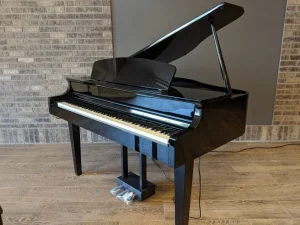
In the CLP-865GP mini grand piano, that speaker system consists of 160 watts of total amplifier power with 4 amplifiers going through 4 speakers. Even though it would appear the specifications of the CLP-845 internal speaker system are better than the CLP-865GP mini grand, the CLP-865GP speaker system is actually optimized for the mini grand cabinet because sound also comes up and out of the top of that mini grand cabinet, so it needs a slightly different internal speaker system as compared to the CLP-845.
Overall I really like the piano sound depth and richness coming out of the CLP-845 and CLP-865GP, but would have preferred a more upgraded internal speaker design in the CLP-835, especially for its price range. Nevertheless, I think for the average person playing the CLP-835, the sound coming out of the speaker system will be fine overall. The ability of the CLP-865GP to sound like a real baby grand piano is impressive, especially if you have a home living room, great room, family room, music room, church, performance venue, or other room that has the space to comfortably fit the mini grand piano. At just 46″ deep the CLP-865GP can fit in many rooms and sound great with its capable internal speaker system.
Cabinet & Design
Over the years we have seen that many digital piano shoppers make purchase decisions with their “eyes” only, when it comes to the way a digital piano looks instead of whether or not that model is actually a good playing piano.Regardless, we know the cabinet size, design, color, and finish can be very important to people, especially if they want the digital piano to fit nicely within the decor of their home, or in a specific room it’s going in.
When it comes to cabinet size, design, and cabinet colors, Yamaha offers a very good selection of cabinet colors and their cabinet designs have always been attractive. We have listed the available cabinet colors, sizes, and weight specifications of each model in our comparison chart above.
In the last few years Yamaha has expanded or changed a few of their cabinet color offerings for their console-upright Clavinova digital pianos. This time they added a special “white Birch” cabinet color with a lighter more trendy color rather than only offering a matte white color for people looking for a lighter cabinet color. The newer white Birch color is definitely attractive as are their more traditional black, rosewood, and white cabinet colors. It depends on your room decor and color scheme and how it will look in there.
Also, unlike a few of the other name brand digital piano brands out there who don’t offer this, Yamaha offers the CLP-835 and CLP-845 in an elegant hi-gloss polished ebony finish, but that one is substantially more money than the regular matte finishes. The CLP-865GP mini grand, which is a beautiful design, comes in either the polished ebony finish or a polished gloss white finish for an additional charge of $1000 more.
In our opinion the additional $1000 for the CLP-865GP in a polished white color is too much of an up-charge for that polished white color. Maybe you really like it and want it bad enough to pay the difference over the polished ebony CLP-865GP, and that’s OK. But for whatever reason Yamaha has it for a lot more money as compared to the polished ebony finish.
As far as the cabinet design differences go between the Yamaha CLP-835 and CLP-845, on the CLP-845 the music rest is larger to hold more or larger amounts music, and the music clips in the piano that hold the music are metal instead of plastic. The CLP-845 weighs a bit more than the CLP-835 because of its wooden white keys and larger internal speaker system. But otherwise the external cabinet measurements are the same on those 2 models.
Final Thoughts - Pluses & Minuses
When you add it all up, you really cannot go wrong with any of these 3 Yamaha Clavinova models.They all offer features and functions in their price ranges which can likely meet the musical and aesthetic needs of most people.Are they the best digital pianos in their respective price ranges out of all the major brands? Maybe yes, but it also depends on what your musical goal is, what your piano playing experience is, and of course, your price range.
These 3 models are built well, and are generally reliable and built to last for many years. Yamaha is an excellent brand for digital & acoustic pianos and they are very popular. They are not the only name brand out there, but they certainly have had a good reputation for many years and we do recommend them.
The Yamaha Clavinova CLP digital pianos have a 5-year factory warranty and it includes in-home service should you ever need it for a warranty issue. Our favorite model of the three would be the mini-grand CLP-865GP because it is so beautiful and sounds great. But, not everyone can afford to be in that price range or has the room for the larger model in their home.
You should definitely consider these Yamaha digital pianos if you are shopping for a very good piano playing experience along with some useful “bells & whistles” features & functions as I have described in this review and as you can see in our detailed Specification Comparison Chart above. Beyond those things, take a look at our “Pluses&Minuses” list below for some of the important things to keep in mind when considering these 3 Yamaha Clavinova models.
Product Pluses & Minuses
P
Comfortable piano-key action that responds well at soft and louder playing levels.
Detailed acoustic-piano sound with natural resonance and good tonal variation.
Clear internal speaker system with enough power for normal home use.
Easy access to commonly used features and helpful app control.
Attractive cabinet design that works well in many living spaces.
M
The control panel may require some practice before all functions feel familiar.
A few advanced editing features are available only through the companion app.
The cabinet is relatively heavy and may require two people to move safely.
Some finish choices cost more than the standard cabinet colors.
Headphones and other optional accessories are purchased separately.
WANT TO SPEND LESS MONEY ON A DIGITAL PIANO WITH EVEN LOWER PRICES? CALL US!
I write the Best, most detailed Digital Piano Reviews in the World and can offer LOWER PRICES too!
About Us
Learn more about the Top Digital Pianos!
Please DONATE to Dylan – My Grandson
My grandson Dylan survived a fatal form of Leukemia when he was very young. However, his continued care is very expensive with other related issues he has from the extensive chemo & radiation Dylan had received along with…
What you need to know about key actions before you purchase a new digital piano or keyboard.
Should You Buy a Used Digital Piano? – 2026 Report
Find out here if buying a "used" digital piano is a good idea. This report could save you a lot of money!
YAMAHA DIGITAL GRAND & UPRIGHT PIANOS – LOWER PRICES!
Yamaha Digital Grand & Upright Pianos at Special Warehouse Discount Prices with an unadvertised large "instant rebate." We will show you how you can purchase one at the LOWEST PRICES.
IMPORTANT SHOPPING TIPS!
Click on the picture and read these IMPORTANT SHOPPING TIPS before you buy any Digital Piano from Anybody!






 Piano Sound Features
 Pedals
 Educational Features



 Factory Warranty


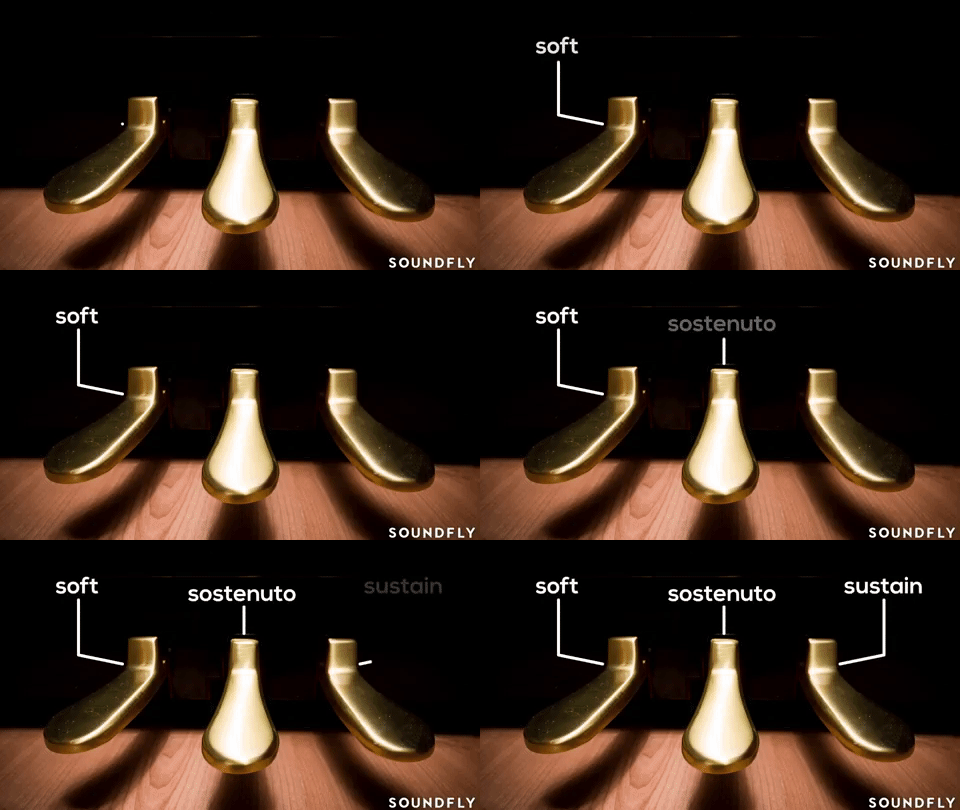 Nearly all full cabinet style digital and acoustic pianos have 3 pedals attached to the bottom center front of the piano. Those pedals are called (from right to left) damper-sustain pedal, sostenuto pedal, and soft pedal. For recreational piano playing, most people will only use the right damper-sustain pedal for sustaining the piano sound when necessary. It takes a while to learn how to use that pedal correctly but it is not difficult and it is definitely important for just about all piano playing for every type of music.


 When it comes to Performance Features in the CLP-835, CLP-845, and CLP-865GP, those things can definitely make the digital piano more enjoyable to play. Not everyone will use those various features described in our comparison chart above, but we like them, they are good to have, and are the same for all 3 Yamaha models. We refer to the Performance Features as being additional fun musical things you can do with these digital pianos when playing them in “real time.”


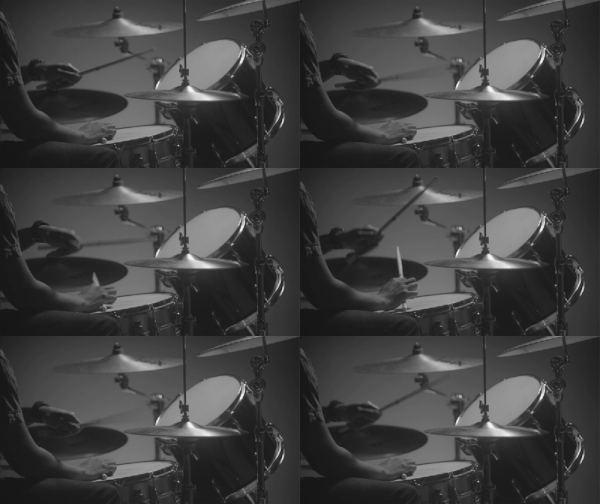 The accompaniment does not have the typical band instrument sounds in them like guitars, pianos, organs, synths, etc. But what it does have is the drummer and bass player for its accompaniment styles, and they are fun to use and they are built into all 3 of these Yamaha models. Other top digital piano brands like Kawai, Roland, Casio, and Korg do not have built-in auto accompaniment arrangements in their furniture cabinet models.


 Grand piano sounds need some “echo” or natural reverb ambience, as an example, to sound more alive with some resonation. Digital pianos are obviously not acoustic pianos and do not naturally resonate through a wooden cabinet with metal strings and a wooden soundboard like an acoustic piano. Digital pianos can make it so you can add these effects to simulate the natural ambience of any size room or acoustic piano cabinet structure.


 The CLP-845 internal speaker system is considerably upgraded as compared to the CLP-835 and it shows in the quality and realism of the piano sounds coming out of it. Now it is true you cannot connect an external power speaker-monitor system to the CLP-835 to enhance the sound, but you shouldn’t have to do that. The competitive brands have 4 internal speakers in their digital piano models in this price range, the Yamaha CLP-835 does not.


